20.04.2026
In the end of April, the University of Latvia (Latvijas Universitate) hosted its 84th International Scientific Conference – a major event bringing together researchers, clinicians, and industry professionals. And we were also there.
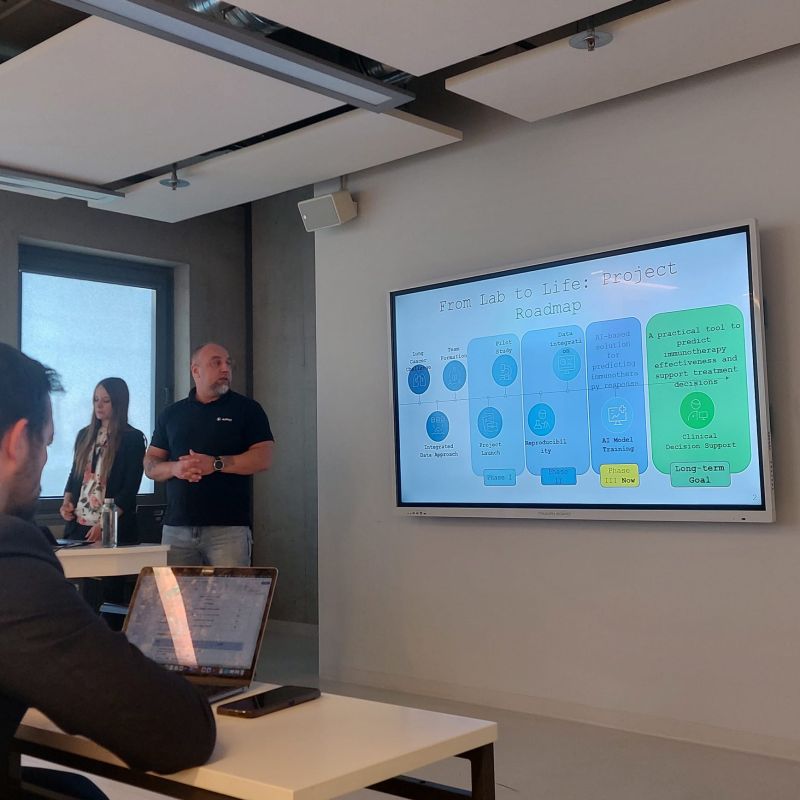
Andis Liepiņš, our Lead AI Architect, together with researcher Lāsma Bugovecka, presented the latest progress in our R&D lung cancer diagnostics project, as part of the session “From Lab to Life: Industry-Driven Innovation”. The project also involves pathologist Professor Sergejs Isajevs and Professor Donāts Erts (Director of the UL Institute of Chemical Physics) as key partners.
🎯 We aim to develop an AI-based decision-support tool for lung cancer treatment, focused on predicting the effectiveness of immunotherapy and assisting clinicians in selecting the most suitable therapy.
What makes this project unique? First, we’re using atomic force microscopy (AFM), a method rarely used in medical diagnostics, to measure the physical properties of tumor cells: structure, density, viscoelasticity. Second, we had to develop a completely new tissue preparation method from scratch. It took more than 10 different approaches and several years to get it right.
The project is structured in three phases, and we are currently in Phase III:
Phase I – Early experiments and pilot study, testing whether AFM can be used on human lung biopsy samples. We developed and validated the tissue preparation approach.
Phase II – Refining the method. Improving measurement reliability, analyzing morphology and surface structure.
Phase III (current) – AI model training. Combining AFM data with clinical and histopathological information to further develop the research foundation for a future practical decision-support tool for oncologists.
So far, the results are promising – adding biophysical features improved classification accuracy from 86.49% to 89.19% using a Bayesian Network model. We’ve also already published scientific papers in two international journals. 📈
Most importantly, the project is moving from experimental research toward practical application. We’re developing a tool that hopefully could one day help doctors make data-driven decisions and predict the effectiveness of immunotherapy. And ultimately reduce lung cancer’s status as one of the deadliest and most difficult-to-treat diseases.
This session, as well as the conference itself, was a great example of what can be achieved when scientists and industry partners collaborate closely, creating a real impact on innovation development.