30.07.2026
AI has quickly become one of the most discussed technologies of our generation. Almost every day, we hear predictions about AI replacing millions of jobs, reshaping entire industries and eventually outperforming humans in almost every field.
Having worked with AI solutions for years and helping organisations understand where this technology can create real value, I have no doubt that AI will change the way we work. However, I am much less convinced by the idea that AI will replace people.
How did the AI “threat” narrative emerge?
Right now, we’re seeing a very active narrative being built around this technology and the AI business, in which humans actually play a much greater role than we’re being led to believe. If we look at where most of the loudest claims that AI will replace humans are coming from, the picture becomes somewhat clearer. Often, this narrative is driven by the very companies that are developing these solutions. Some of the most apocalyptic statements have come from “OpenAI,” the creators of ChatGPT, but not only from them. And this is not only logical but, in my opinion, absolutely inevitable, given that, due to high resource costs, a large portion of these product developers are still operating at a massive loss. To continue to survive and grow, and to attract investment, customers, and attention, it’s not enough to simply feel that this technology is useful; it’s necessary to create the conviction that life without it is unimaginable.
There is no doubt that AI should be introduced into the workplace, as it can create significant value. However, it is equally important to critically examine the claims made by AI companies and the circular capital market dynamics that receive far less attention. In this ecosystem, companies can simultaneously act as customers, investors and beneficiaries of investment.
For example, Nvidia, one of the leading US technology companies developing and manufacturing graphics processors, invests in OpenAI. OpenAI receives this capital and uses a significant share of it to purchase Nvidia’s products and infrastructure. Nvidia’s revenues grow, its market value increases, and it gains even more capital to invest in other AI companies – which, in turn, also become customers of Nvidia.
The traps set by the generative AI industry
This is precisely where one of the biggest pitfalls created by generative AI developers lies. Users may think that about 30 euros a month is enough to perform a very wide range of tasks with the help of generative AI, but in reality, the actual costs of getting that work done are being shifted to the major model developers. They are currently willing to subsidize these costs in an effort to replace our employees, hoping to gain a larger market share in the future. Even now, with the help of generative AI, it is possible to perform almost any office task – preparing reports, compiling information, and so on. However, looking at the big picture, this consumes a very large amount of tokens (or units of information), electricity, and financial resources. The total costs can easily exceed a person’s monthly salary, whereas a person can often complete the same task for just a few dozen euros. Even now, it is possible to find situations where human labor is more cost-effective for a company than using AI.
It is often argued that AI will become cheaper over time. However, this will most likely give rise to other challenges in which the cost issue will resurface. Currently, for major generative AI developers, token costs are significantly higher than the revenue they receive from users, and this difference is covered by investors. To achieve a sustainable business model in the future, AI models could become more narrowly specialized and less resource-intensive, consuming fewer tokens. However, the costs of using them will rise significantly, and advertising will become increasingly widespread. OpenAI is already integrating ads, and given generative AI’s ability to influence human perception, the use of advertising may become even more aggressive in the future. Thus, we may end up in a situation where, in the name of a single “chatbot,” companies will lay off all their employees, leaving them without human resources or the flexibility that human minds provide, yet with AI costs equivalent to the salaries of real people. Not to mention that, once again, all the world’s money will flow to the U.S. Of course, this is currently an “exaggeration,” but it helps illustrate the hopes placed on technology.
Why humans will still matter more than algorithms
In discussions about the future of AI, people themselves – and their psychological makeup – are often overlooked. Human needs are constantly changing – society is seeking new experiences, unique solutions, and opportunities to stand out. It is precisely in this regard that the role of humans will remain essential, because AI alone cannot generate entirely new ideas but operates based on previously accumulated knowledge and human-generated experience. If the world were to suddenly come to a standstill and people were no longer to invent or create anything new, theoretically, after a certain amount of time, AI could absorb all the knowledge accumulated by humans and replace many processes. However, in reality, human needs continually evolve, creating new challenges that require innovative solutions. AI can be highly effective in creating standardized products and services, but the foundation of entrepreneurship often lies in the ability to create something more than just a “good enough” solution. Entrepreneurs are constantly looking for ways to differentiate themselves from competitors, and this process will never stop.
Why economic realities will prevent AI from taking over everything
Another aspect to consider is economic reality. A scenario taken to the point of absurdity, in which AI replaces absolutely all human jobs, creates a paradox in and of itself – if people no longer have jobs or income, there will be no consumers to purchase the products and services produced by companies. The economy is based on a cycle in which people work, earn income, and spend it on goods and services. Therefore, completely removing humans from this chain would not only be a technological challenge but also an economic dead end. A much more plausible scenario is the interaction between humans and AI, where technology helps humans become more productive rather than completely replacing them. We must also consider the very reason for AI’s existence. It was essentially created to meet human needs – to make work easier, speed up processes, and solve specific problems.
Technology itself has no needs, desires, ambitions, or goals that it would strive to achieve for its own sake. It merely carries out the tasks assigned by humans. The rise of AI can be compared to the invention of photography, which at the time diminished the importance of painting as the primary medium for depicting reality. However, it did not destroy art – on the contrary, it fostered the development of new movements, such as Impressionism, Modernism, and abstract art. Similarly, AI can transform the human creative process without rendering it obsolete. As for the hype surrounding technology, parallels can be drawn with the “dot-com” bubble of the early 2000s. At that time, there was a widespread belief that brick-and-mortar stores would soon disappear, as all commerce would move online, advertising would take place exclusively in the digital sphere, and the number of internet users would become the primary indicator of a company’s success. In reality, however, brick-and-mortar stores have not disappeared, and traditional advertising still exists. Meanwhile, many investors lost significant amounts of money in companies that failed to live up to their overly optimistic projections. A similar situation could repeat itself with today’s AI hype – the technology will remain and transform many processes, but it will not replace everything that existed before it.
Errors and Liability
No matter how capable generative AI may seem to us, it still makes many mistakes, and someone must be held accountable for them. This raises the question of whether a person or organization is prepared to take responsibility for the decisions made by AI. This applies to various industries. From an IT perspective, everyone now agrees that informational websites, standard online stores, or other non-critical applications could be programmed perfectly well with the help of AI. On the other hand, none of the developers I know would entrust business-critical systems – which process hundreds of thousands of euros in transactions daily – to AI agents. Because we wouldn’t be able to catch all the errors or handle all the edge cases. Alternatively, this verification and debugging would take a human more time than writing the programming code from scratch. But the responsibility would fall not only on each programmer but also on the organization, which has a contractual financial liability to its clients.
In this regard, two very serious “Amazon” e-commerce incidents that occurred in March of this year come to mind; these were discussed in the public sphere as errors in AI-generated code. The company’s rapid reliance on AI coding tools led to several serious operational disruptions in both its e-commerce and cloud services businesses. Following the failed implementation of an AI agent, the company was forced to take a step back – launching an emergency security audit, implementing a code review process, and reinstating stricter human oversight of AI-generated code. Amazon’s official stance was cautious, but it did acknowledge one of the incidents. Thus, we see that humans remain – and will continue to be – an integral part of technology. It’s also important to remember that, as a result of the development of business-critical systems, the code used in programming is protected by intellectual property rights. It is hard to imagine why a client or system developer would even want to hand over this code for AI training or for use by competitors. That is why, even in the IT industry, it is difficult to imagine that a good programmer could be replaced in the foreseeable future.
Why Entry-Level Employees Aren’t Going Anywhere
Another aspect worth considering is the assumption that AI might, in the future, replace only certain skill levels, particularly entry-level professionals. Recently, we’ve been hearing more and more often that companies will no longer have an economic rationale for employing entry-level workers, since AI will be able to handle part of their work. Although this solution may seem more financially advantageous in the short term, in the long term it would create a situation similar to clear-cutting a forest. If an entire forest is cut down and no new trees are planted in its place, at some point there will be no resources left to use. The same applies to the labor market – top-level experts cannot advance without first gaining experience as junior and mid-level specialists. In the future, it will be challenging to employ only top-level experts, as there simply won’t be enough of them. Even if we assume this scenario theoretically, these people would become a highly scarce resource; companies would compete for them and pay increasingly higher salaries.
As a result, economic logic would once again lead to the conclusion that it is more cost-effective to train and develop new professionals ourselves so that they can eventually become experts. Thus, in the long term, the economic system will find its own balance in this area as well, maintaining the need for professionals at various levels. It can be anticipated that in the near future, rather than seeing humans replaced by AI, we will see a clearer division of roles between AI-driven automation and human-generated added value. People and companies that learn to use AI as an assistant in their professional fields and combine the capabilities of technology with their own knowledge and experience will be able to develop more quickly and become more productive.
How to Stay Rational During the AI Hype Cycle
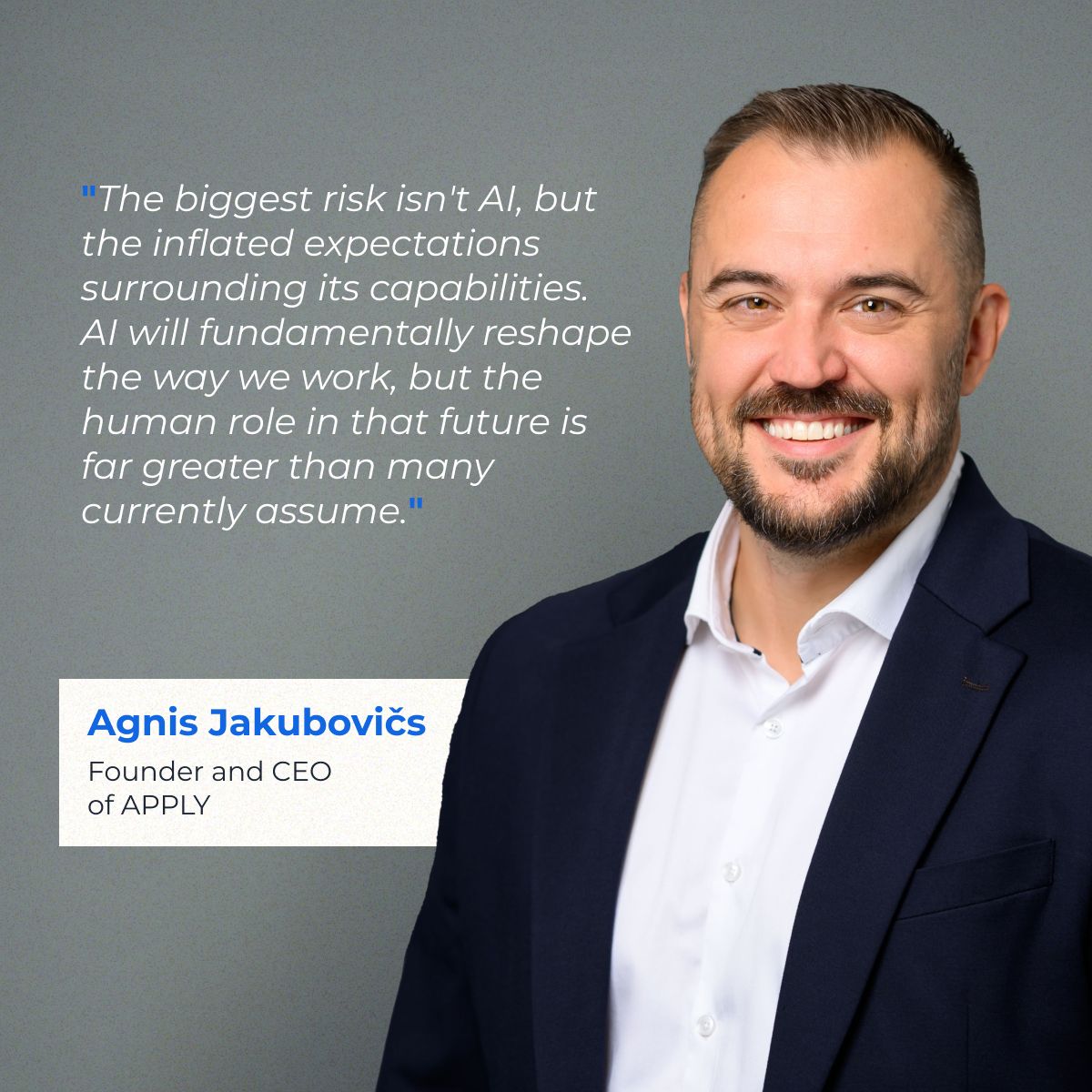
AI is an important and necessary tool for making everyday work easier, especially in a professional setting. Human involvement will still be necessary, but the technology allows work to be done faster and with less effort. Both generative AI solutions – or large language models – and narrowly specialized, independent solutions – or “EdgeAI” – will continue to change the way people work. However, the greatest risk is not the technology itself, but rather the way society reacts to it. The most important thing is to maintain a balance – to take advantage of the opportunities AI offers, while at the same time not losing our critical thinking and ability to assess the true benefits of the technology.
AI is a great and certainly necessary tool for making our daily lives easier, but human involvement is still essential. The most important thing is to understand whether AI truly adds value in a given situation. If calculations show that the innovation will recoup the investment within two years, the project is worth implementing. However, not every new tool should be adopted simply because it is popular, and not every problem needs to be solved with the help of AI.